
We build AI that gets opened on a Tuesday morning.
Artwing Studios builds AI systems for businesses: AI agents, WhatsApp agents, workflow automation, custom CRMs and ERPs, dashboards and internal tools. We also build and run our own AI products — Workzap pi, a WhatsApp agent, and Workzap nori, a nightly read for retail chains. We work across Pakistan, the UAE, Canada and the USA.
Watch one of ours work
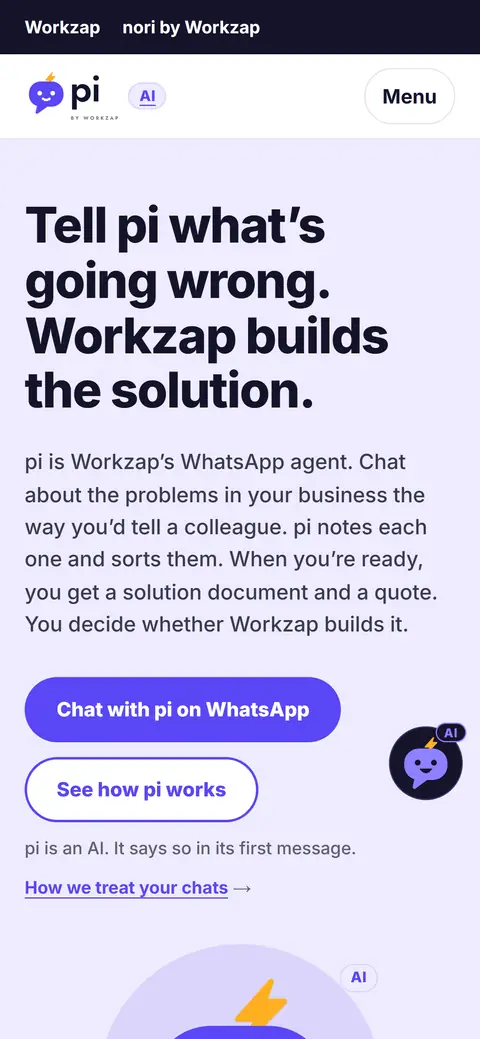
Most AI pages describe a capability. This one shows you a system that is live right now, on WhatsApp, that you can message yourself in the next minute. It is called pi, we built it, and here is exactly what happens.
Stage 1: A message arrives
A business owner opens WhatsApp and types the thing that is annoying them. Not a form. Not a dropdown that makes them classify their own problem before anyone has listened to it. "Stock keeps running out in the Lahore shop and I only find out when a customer asks."
Stage 2: pi listens, and does not pitch
pi tells you in its first message that it is an AI, and says so again any time you ask. Then it asks questions about the problem and nothing else. It will not suggest a fix while you are still explaining — which sounds like a small thing until you remember the last salesperson who did the opposite.
Stage 3: The problem gets sorted, not solved
Each thing you mention is noted and filed by type, so you never have to say it twice and nothing gets lost between messages. Three complaints that are really one problem get recognised as one problem. One complaint hiding three problems gets split.
Stage 4: A document, not a sales call
You get back a written solution document built from your own words, and a quote with cost, scope and timeline on it. You read it on your own time, with nobody on the other end of a phone waiting for an answer.
Stage 5: You decide, and nobody takes your money in a chat window
Approve it, ask for changes, or say no. Payment never happens inside the chat. If you approve, Workzap starts with a kickoff call and a human being.
That is one agent doing one job properly. Every system we build has the same four parts: something the customer already uses as the way in, a model that understands the mess, a structured output a person can act on, and a human with the final say. Change the way in to a web form, a phone call or a row in a spreadsheet, and the shape holds.
What we build
- AI agents
- Software that holds a conversation, does the reading, and hands a person something they can act on. We build agents for one job at a time, because an agent with one job can be tested and an agent with nine cannot.
- WhatsApp agents
- In Pakistan and the UAE, WhatsApp is not a channel — it is where the business happens. We build agents that live there: taking enquiries, answering the same twelve questions correctly at 11pm, qualifying leads, and passing a written brief to a human when the question stops being routine. pi is ours, and it is the proof.
- Workflow automation
- The jobs someone on your team does by hand every week because the two systems you pay for do not talk to each other. We connect them, write the rules, and put a log on it so you can see what ran and what it changed.
- Custom CRMs and ERPs
- When the off-the-shelf system needs eleven workarounds, the workarounds are the system. We build the thing your business actually does, with your stages, your terminology and your approvals — and we run our own agency on one we built for ourselves, a.hub OS.
- Dashboards
- Not a wall of charts nobody reads. One screen that answers the two or three questions you open it to ask. nori, our retail product, exists because the brief was a single morning read instead of a dashboard — sometimes the right answer to "build me a dashboard" is "read it for me".
- Internal tools
- The small ugly software your team needs and no vendor sells: the approval screen, the uploader, the thing that checks the spreadsheet before it goes to the client. Fast to build now, and the highest-return AI work most businesses are ignoring.
Two of them are our own products, which is the only reference that counts
Anyone can show you a slide of an AI system. We have two in the market with our name on them, which means we carry the support calls, the bad reviews and the server bills.
Where this is going, and what we ship today
Today we ship narrow systems that do one job in front of a person who can overrule them. None of them runs a business on its own.
What we build now are the habits that will matter later: one clear job per agent, a human decision at the end of every chain, a log of what the system did, and saying "it cannot do that yet" out loud. If the models get much better, those habits are what lets you move. If they do not, you still have software that works.
How a build starts
With a call where we try to talk you out of the expensive version.
Tell us the job you want done — not the technology you have read about. We will tell you whether it needs an agent, an automation, a dashboard, or forty minutes with your existing software and nothing new at all. Then you get a scope and a quote in writing.
Every AI system gets its own timeline, written down before anyone starts.
Prefer to talk first? Call or WhatsApp us.